

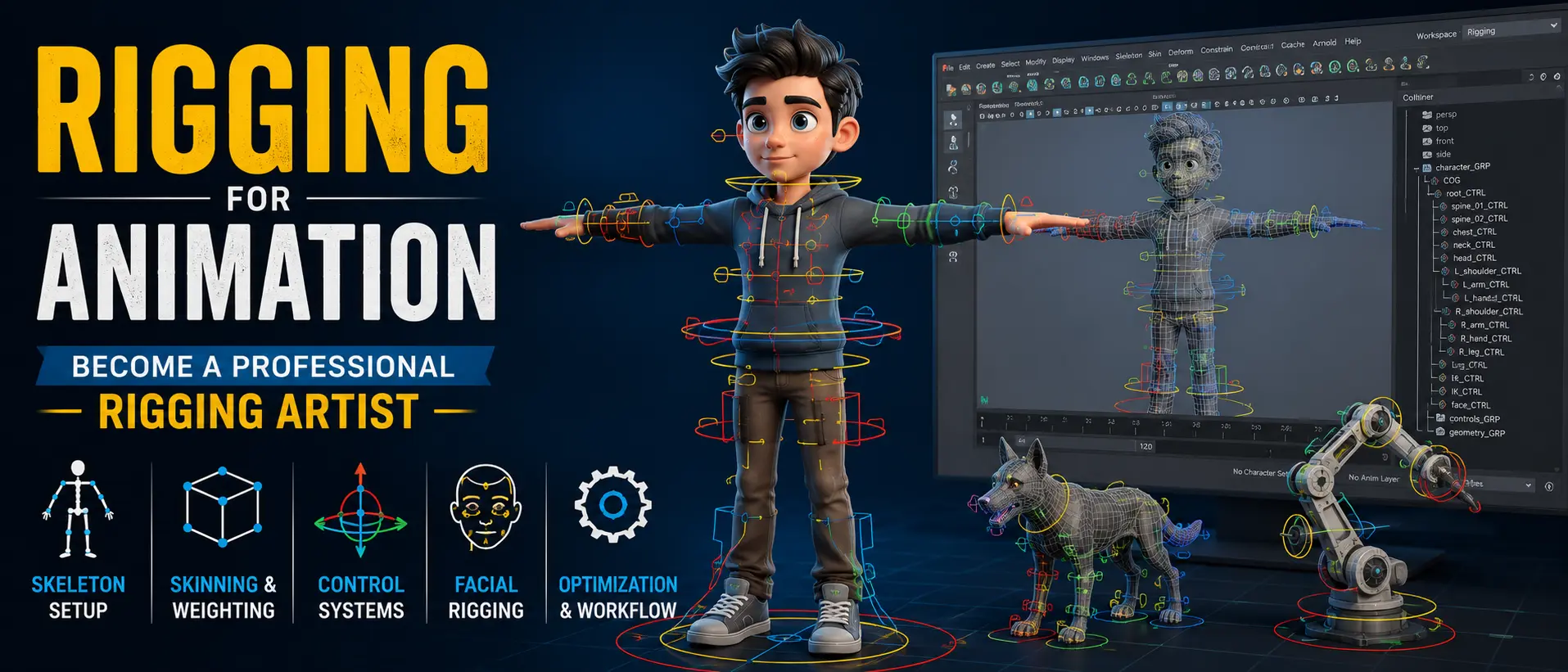
When watching an animated movie or playing a modern video game, it's easy to admire the realistic movements of characters and creatures. However, before an animator can make a character walk, jump, smile, or fight, the model must first be rigged. This crucial process is known as rigging for animation.
Rigging is one of the most technical yet rewarding areas of 3D production. It combines creativity with problem-solving to create digital skeletons and control systems that bring static models to life. You
If you're interested in animation, gaming, or visual effects, becoming a Rigging Artist can lead to an exciting and in-demand career. For that you can choose best course for rigging.
Rigging is the process of adding bones, joints, controllers, and movement systems to a 3D model so that it can be animated. Just as the human skeleton supports body movement, a digital rig provides the structure needed for a character or object to move naturally.
A well-built rig allows animators to create smooth and realistic actions while maintaining consistency throughout a project. Rigging is used for characters, animals, robots, vehicles, and even mechanical objects in films and games.
A Rigging Artist is responsible for preparing 3D models for animation. Their work involves creating skeletal systems, designing animation controls, testing deformations, and ensuring that characters move correctly in different poses.
One of the most common types of rigging is character rigging, which focuses on preparing human or creature models for animation. It involves creating a digital skeleton, assigning skin weights, and building intuitive controls for body movements and facial expressions.
Good character rigging allows animators to produce lifelike performances, realistic gestures, and smooth motion without technical complications.
Rigging serves as the bridge between modeling and animation. Without it, even the most detailed 3D model cannot move or express emotions.

Adobe Photoshop

Adobe After Effects

Adobe Premiere

Adobe Audition

Autodesk 3ds Max

Autodesk Maya

Unreal Engine

Adobe Substance 3d Painter

VRay

Marvellous Designer

Quixel Mixer

Storyboarder

Autodesk Maya - XGen

Adobe Stager

Adobe Sampler

Chatgpt

Deep Seek

Leonardo AI

Midjourney AI

Sora AI

Runway ML

ElevenLabs

Suno AI
Learn 3D Animation Fundamentals : Understand modeling, texturing, lighting, and animation workflows.
Master Rigging Software : Practice creating skeletons, control systems, IK/FK setups, constraints, and deformation rigs.
Study Anatomy and Motion : Learn how humans and animals move to create believable character rigs.
Build Practical Projects : Create rigs for characters, creatures, robots, and props to improve your skills.
Develop a Portfolio : Showcase body rigs, facial rigs, deformation tests, and animation-ready characters.
Keep Learning : Stay updated with new rigging techniques, scripting tools, and production technologies.
With the rapid growth of animated films, AAA games, virtual reality, and digital content creation, the demand for skilled rigging professionals continues to increase.
Studios seek artists who can create efficient, flexible rigs that support high-quality animation while streamlining production.
Rigging for animation is one of the most essential steps in the 3D production pipeline. By creating the systems that allow characters and objects to move naturally.
Whether you're interested in films, gaming, or visual effects, learning rigging can open the door to a rewarding creative career. With the right training, practical experience, and a strong portfolio, you can establish yourself as a valuable professional in the ever-growing animation industry.
The salary of a Rigging Artist in India depends on experience, skills, and the company. Entry-level professionals typically earn between ₹3–5 LPA, while experienced rigging artists can earn ₹6–12 LPA or more. Those working in top animation, gaming, or VFX studios or with international clients may receive even higher compensation.
There is no mandatory degree required to become a Rigging Artist. However, having training in 3D animation, character rigging, or computer graphics can be highly beneficial. Strong knowledge of software like Autodesk Maya or Blender, along with a solid portfolio and practical skills, is often more important than formal academic qualifications.
Rigging can be challenging because it requires technical problem-solving and attention to detail, especially when working on complex characters or meeting project deadlines. However, many professionals find it rewarding and enjoyable, particularly if they like combining creativity with technology and working behind the scenes to bring animated characters to life.